
For years, major social media platforms have maintained tight control over what users see in their feeds. While users have always had basic tools such as following accounts, liking posts, or hiding unwanted content, the underlying recommendation algorithms have ultimately determined what appears in front of them.
Now, however, platforms are beginning to shift that balance of power by introducing new tools that allow users to personalize their algorithms with the help of artificial intelligence.
Beyond traditional options like “Not Interested” buttons, apps such as Threads, Instagram, and TikTok are rolling out features that let users actively shape and “train” their own recommendation systems, influencing the content that appears in their feeds.
This shift represents a broader evolution in how recommendation systems function. Social media feeds are gradually moving away from a fixed, one-size-fits-all model—similar to a traditional TV broadcast—and toward something more flexible, resembling streaming platforms where users can fine-tune recommendations based on personal preferences and interests.
For users, customizable algorithms offer the promise of more relevant and enjoyable feeds. For social media companies, they also serve as a way to increase engagement by ensuring that users are shown content they are more likely to interact with.
Below is a breakdown of how different platforms are giving users greater control over their recommendation algorithms.
Threads
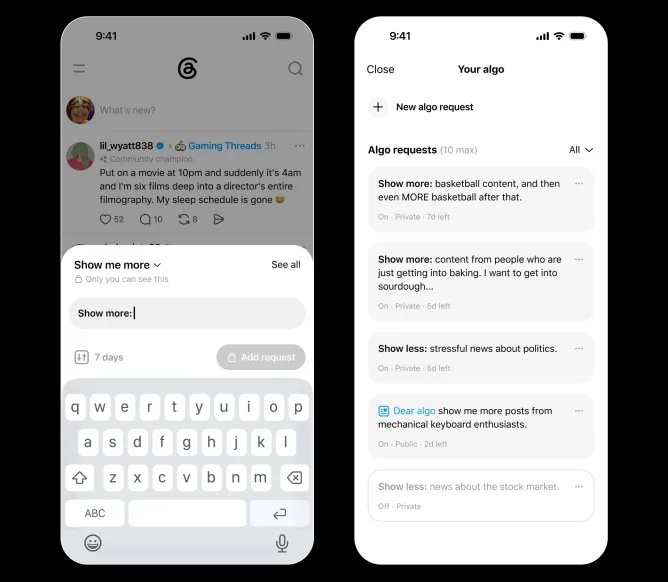
On June 16, 2026, Threads introduced a new feature called “Your Algo,” expanding on its earlier “Dear Algo” tool, which launched in February. The original “Dear Algo” feature allowed users to influence their feed by publicly posting prompts such as “Dear Algo, show me more posts about podcasts,” signaling the types of content they wanted to see more or less of.
With “Your Algo,” users can now make these preferences privately, without needing to post them publicly.
The feature allows users to request more or less content on specific topics and also choose how long those preferences should apply—options include one day, three days, or seven days. For example, a user could temporarily increase the amount of baseball-related content they see while reducing exposure to stressful news.
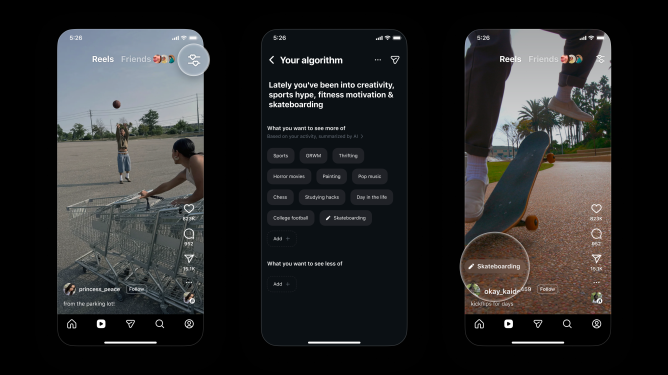
In early June, Instagram launched a new tool that gives users more visibility and control over the algorithm shaping their feed. Known as “Your Algorithm,” the feature allows users to see which topics are currently influencing their recommendations and adjust them to better reflect their interests.
The tool was initially introduced for the Reels feed in December 2025, but has now been expanded to cover the main feed, Explore page, and Reels more broadly.
Once accessed through the settings menu, users are shown a list of topics that Instagram’s system believes are most relevant to them. From there, they can indicate which topics they want to see more of and which they want to see less of, allowing the recommendation system to adapt accordingly.
Instagram head Adam Mosseri has previously stated that traditional ranking systems have often been opaque and difficult for users to understand. He has suggested that advances in large language models (LLMs) can make recommendation systems more transparent, both by explaining why certain content is shown and by allowing users to directly express their preferences in natural language.
TikTok
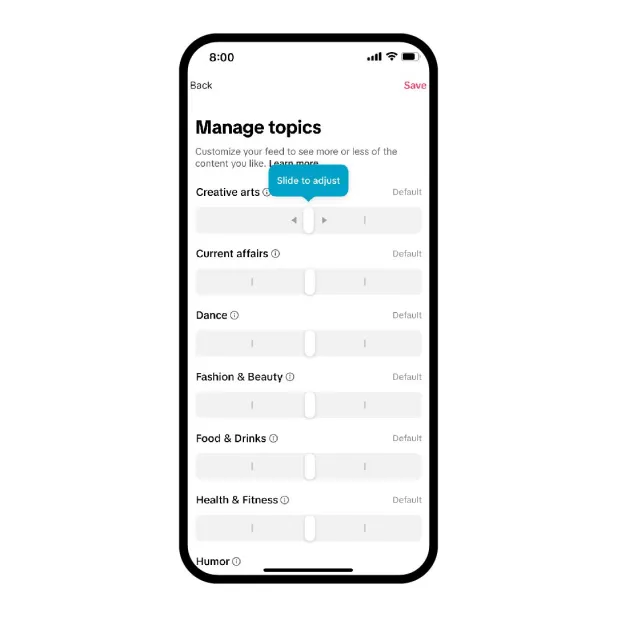
TikTok offers a feature called “Manage Topics,” which gives users more control over what appears in their “For You” feed. First launched in 2024, the tool can be accessed through settings and allows users to adjust how frequently they see content across different categories, including sports, travel, humor, current affairs, dance, and food.
Users can adjust their preferences using a slider that increases or decreases the amount of content they receive from each topic in their feed.
To help users better understand classification, TikTok provides additional information for each category. For example, the “Creative arts” topic includes content such as painting, drawing, graphic design, and art-related tutorials.
In 2025, TikTok expanded this system by introducing AI-powered Smart Keyword Filters. This feature automatically filters out not only selected keywords but also related terms and synonyms. For instance, if a user chooses to filter out the term “remodeling,” TikTok’s system may also filter related terms such as “renovation” and “renovations,” further refining the user’s content experience.